The behind-the-scenes story of our commitment to more sustainable operations.
Today’s Olympic Authority venues are year-round destinations with wide-ranging activities and events throughout the year.
Still, one season rises above all others.
For us, winter is where it all began. It’s the foundation on which everything around us was built – our communities, our venues, our history, our economies, and our way of life.
But the season we cherish is changing. Snowfall is less reliable, and the season itself is shorter. That’s why all of us here at the Olympic Authority are even more dedicated than ever to planning proactively and taking action to protect winter sports and our natural environment in the Adirondacks and Catskills.
Of course, the many solutions implemented across our venues cannot by themselves solve this problem for all of planet Earth. Nevertheless, we remain fully committed to serving globally as leaders in preserving winter. For winter sport venues everywhere, we are demonstrating how to make changes that will help stabilize our climate. At the same time, this work makes us increasingly resilient at home, enabling our venues to maintain our winter sport heritage and help our communities thrive.
After all, our mission involves far more than hosting events and selling tickets. We’re here to preserve our heritage, drive our economy, and contribute in meaningful ways to the lives of people across our great state and beyond.
REVOLUTIONIZING ENERGY USE ON OUR MOUNTAINS
In this age of warming winters, the good people at all our ski areas – Belleayre, Gore, Whiteface, and Mt Van Hoevenberg – are making more snow to ensure the skiing and riding experience is the best it can be.
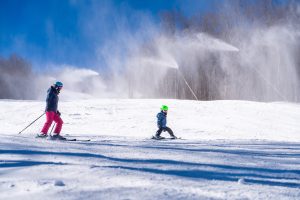 But instead of just using more energy and water to make more snow, we’re making every part of our operations smarter and more efficient, too, to improve our energy efficiency. In the past decade alone, we achieved great changes, and our work continues.
Our teams advanced our use of renewable energy sources, installed high-efficiency snow guns, improved our water pumping systems with high-tech controls up and down the mountain, and initiated many other key innovations. Whiteface and Gore, for example, both have large solar arrays providing power for their high efficiency snowmaking systems. Gore’s solar array, in fact, is the largest in the U.S. dedicated to a ski area.
But that doesn’t cover all our electricity needs, so we are achieving further reductions in emissions by purchasing green power through the New York Power Authority (NYPA). With that source of renewable power, Whiteface and Belleayre are operating at zero emissions in their use of electricity.
AIR & WATER AT HIGH PRESSURE
The most energy intensive part of the snowmaking process is pushing air and water at high pressure through snow guns. The result is a mist of microscopic water droplets being driven airborne with a hang time long enough to freeze on the way down.
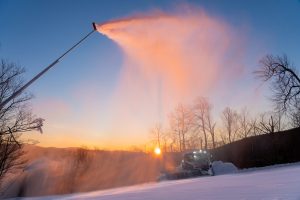 Older guns used around 500 cubic feet of air per minute (CFM) whereas the newer HKD high efficiency guns now in use across our mountains use a mere 100 CFM, depending on temperatures and the volume of water operators are pushing through the system (lower temperatures allow less water use to make more snow). Using far less air, the new snow guns are up to 90 percent more efficient and cut electricity use by 30 to 50 percent for the same amount of snow produced.
Another part of that system is the compressors that push air through the system. Previously, they were massive diesel machines. Those we replaced with larger, high-efficiency electric compressors that work with the rest of the system to minimize energy costs and emissions.
ADVANCES FROM BOTTOM TO TOP
As for the technologies that pump water up our mountains, they are also greatly improved. To best protect our water resources and to more efficiently use our permitted withdrawal capacities, we overhauled all our pumphouses and water distribution systems.
The older controls were rigid, fixed-speed setups that could not help but use excess water and energy. Today, they’re smart, variable-speed networks called Variable Frequency Drives (VFDs) that optimize energy use, water flow, and pressure in real time.
VFDs conserve power by not only controlling the rate at which water is withdrawn for snowmaking but also precisely matching the number and location of active snow guns with the exact volume of water they require. This advanced VFD technology is a powerful tool that enables our teams to adjust all aspects of snowmaking operations to changing weather conditions and to fully optimize their output.
Because compressing air accounts for up to 75% of total snowmaking energy costs, our pumphouse upgrades yield huge paybacks. Additionally, the VFDs greatly reduce energy use and improve overall efficiency by 60 to 70 percent.
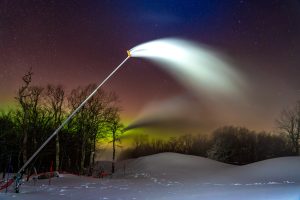 While a VFD powers and controls specific motors, our snowmaking advances also include centralized monitoring and management networks called Supervisory Control and Data Acquisition systems (SCADA). SCADA gathers real-time data from field sensors and displays the status of the various elements of snowmaking operations for our human plant operators. In this way, each of our teams can use one central control panel to more efficiently manage all the pumps, compressors, and valves used across their mountain.
This highly advanced ability to remotely control snowmaking infrastructure also reduces the duration of its use. Although guns can always be manually shut off, this additional technology further decreases the energy costs of snowmaking as well as the time and labor involved. These systems and their operators communicate directly with snow guns to adjust water pressure and flow as temperatures and humidity shift – all of which improve our ability to make more snow more efficiently and open more trails earlier each season.
We’ve also taken these system controls one step further by combining them with more advanced weather monitoring. The two together mean our mountains’ teams are making the most of even short periods of cold weather.
TAKING FLIGHT TO OPTIMIZE OPERATIONS
Yet another innovative way our teams are transforming snowmaking operations is by gaining an entirely new perspective. Using drones, they map each mountain’s terrain prior to winter to produce an accurate baseline for decision making throughout the season. Then with GPS-equipped snowcats, our grooming staff can see exactly where snow is thick or thin, enabling them to make decisions in the moment on how to best move and distribute snow across the trails.
Drone imagery also helps the snowmaking teams see where snow is most needed, so they can avoid overproducing snow and ensure the best, most efficient use of equipment.
SHAPING TRAILS FOR SUSTAINABLE SNOW
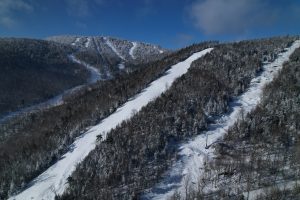
By carefully smoothing the ski terrain itself, our mountain teams optimize retention of snow throughout the year as well as the efficiency of equipment to make and groom our trails. Thoughtfully shaping trails to match natural contours improves water drainage, helps prevent erosion, and eliminates hidden dips that require extra snow by trapping it where it’s not useful. By also removing sharp knolls, filling the hollow spots, and softening the extreme side-hills, groomers can operate their equipment more safely and more efficiently.
This cropping of obstacles and smoothing minor bumps means less total snow depth is required just to achieve full, safe coverage while also modifying how snow blows across trails to prevent high winds from creating bare spots. More even and predictable slopes reduce the need to make higher numbers of massive snow “whales” that require extensive grooming. In that way, snowmakers can more easily build a uniform base layer year after year that requires less time and fuel to push and less wear and tear on grooming equipment.
CENTURIES-OLD WISDOM REVIVED
The team at the Mt Van Hoevenberg Nordic ski center is implementing an ancient and incredibly simple idea that is updated for a new purpose. Initiated in 2025, their snow storage initiative is an important advancement
After making snow when conditions are at their best, the trails crew stockpiles it throughout the winter in the expansive 1980 cross-country stadium area. Covering it with an insulating layer of wood chips preserves it through the summer. Then, to kick start the next season, it’s all right there ready to use.
Storing snow makes for easy, fast coverage of basic terrain to allow cross country skiers to get started around the same time the snowmaking season gets in gear, too.
 SUSTAINING WINTER SPORTS
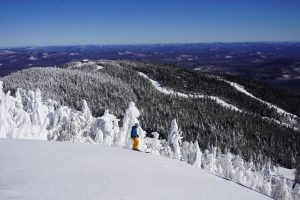
We all love natural snow the best, but with warmer winters already upon us, snowmaking is crucial. With today’s more advanced, high-efficiency systems installed across our mountains, Olympic Authority ski areas – alpine and Nordic – are providing more reliable snow conditions, extending ski seasons, and maintaining opportunities for winter sports and recreation. It’s also crucial for continuing to attract national and international competitions to our venues, too.
BEYOND SNOWMAKING
Not to be overlooked are other operations that also produce CO2 emissions, such as the use of fuel oil, gas, and diesel to power heating systems as well as snow grooming machines and other vehicles.
One of the biggest moves in this category was making the shift away from fuel oil to propane, which is far cleaner and more environmentally friendly.
In some of our mountain lodges, we made an even more environmentally friendly transition to heat pumps that use electricity rather than burning fuel. In our case, that’s electricity generated from renewables. Heat pumps are innovative systems that transfer heat in a process that cycles refrigerant to perform both heating and cooling of indoor spaces. In winter, the systems absorb heat from the outside air – even in cold conditions – and release it indoors. In summer, the systems reverse that flow to absorb indoor heat and expel it outside.
Across all Olympic Authority venues, we are shifting away from fossil fuels, reducing or eliminating them in all new construction and avoiding any new systems or equipment that uses fossil fuels. The improved efficiency of our current and future systems combined with our use of renewable energy is the right thing to do to fulfill our commitment to preserving winter and our environment.
 ELECTRIFYING OUR FLEET
On a visit to any of our venues, you will see electric vehicle charging stations. In addition to encouraging visitors to drive electric vehicles, the Olympic Authority is transitioning its own fleet to electric as available technology and replacement schedules permit.
Our hybrid groomers are a great example. Their electric drive motors are surprisingly powerful and can immediately provide high levels of torque at low speeds, which improves performance when pushing heavy snow. Going downhill, the electric motors automatically capture braking energy to recharge the battery. Hybrid groomers also operate considerably quieter than the standard machines, providing an important added benefit to the natural environment on our mountains.
The hybrid PistenBully 600 E+ snow grooming machines on our mountains are currently the cleanest and quietest in the industry, reducing both emissions and noise pollution while increasing performance. Across our venues, we are actively transitioning our entire fleet of vehicles and groomers to electric vehicles as technology and replacement cycles allow.
ICEMAKING INNOVATIONS
Winter in Lake Placid isn’t just about snow. High-quality ice for skating, hockey, bobsled, skeleton, and luge, are vital, too. After all, a great deal of our history was made on ice. From the first bobsled track ever constructed in North America to the first indoor skating arena ever used in the Olympics to that famous 1980 miracle on ice game to tens of thousands of visitors coming each year for CAN/AM Hockey Tournaments, our legacy glides on great ice.
To continue advancing that legacy while advancing our leadership in environmentally sustainable operations, we have made operations smarter and more efficient at our Olympic Center and our tracks at Mt Van Hoevenberg, where we maintain world class ice surfaces for skating and sliding sports.

Along with Olympic Center renovations several years ago, we replaced a nearly half century old refrigeration system. The new one serves all three indoor ice surfaces as well as the outdoor speed skating oval. Controlled with VFDs, that system maintains outstanding ice for training, competition, and recreational skating in addition to monitoring and maintaining temperatures inside the arenas. Synching these controls provides a comfortable environment for spectators while simultaneously creating the best possible ice conditions for skaters and hockey teams.
At Mt Van Hoevenberg, the mile-long combined sliding sport track requires a large refrigeration system. There’s also the indoor push track for training – the only one in the U.S. – on which athletes at all levels from all over the world train year-round. The outdoor track is continually in use for training and competition from November through March.
The new refrigeration plant, fully operational as of this year, replaced the old and inefficient one originally installed in 1978. Ammonia is the heat transfer agent that travels through miles of pipes up and down the track, and it’s among the best and most natural refrigerants. The new plant is a vast improvement with excellent insulation, high-efficiency pumps, and VFDs that automatically and instantaneously adjust power use throughout the system.
LIGHTING SOLUTIONS
Across all Olympic Authority venues, our teams are systematically replacing old lighting fixtures with far more efficient and more effectively controlled LED lighting. Even without considering their advanced controls, LED lights save as much as 90 percent over the old incandescent and fluorescent bulbs. That’s because LEDs convert 80 to 90 percent of their electrical energy directly into light, whereas old incandescent bulbs turn 90 percent of their energy into wasted heat.
 Major LED lighting projects have made a difference inside buildings but also on the field of play at the Olympic Jumping Complex and the sliding track at Mt Van Hoevenberg.
Ski jumping competitions, in particular, often take place at night, and athletes require intense lighting to practice their sport safely. In addition to greatly reducing energy use, the new LEDs are down-focused, precise, and infinitely dimmable systems that create the best, safest environment for training and competition while avoiding light pollution into the Adirondack nighttime skies.
The new system at the combined sliding track at Mt Van Hoevenberg is similar, as the entire track requires lighting for safe training and competition in low light conditions. Improvements to the track also include new roofing and covering systems that further prevent nighttime light pollution.
ADDITIONAL SUSTAINABILITY MILESTONES
Preserving our winters is an ongoing practice. As this vital work continues, other new practices and milestones are also important to note:
-
- Currently initiating use of infrared heaters in appropriate spaces to provide direct, efficient warmth using electromagnetic waves instead of blowing hot air. This technology converts nearly 100% of the electricity used into heat while also eliminating energy lost to empty spaces or ducts.
-
- Continuing to expand recycling programs at all venues, including composting.
-
- Creating reusable signage and other sustainable logistics for major events.
-
- Choosing to repurpose materials, lifts, and other infrastructure as an additional way to recycle. Gore Mountain’s donation of an older triple chairlift to McCauley Mountain Ski Center in Old Forge is an example.
-
- Increasingly using locally or regionally produced foods in cafeterias across venues to better serve regional economies, improve the quality of our menus, and greatly reduce transportation impacts.
-
- Recycling of used staff uniforms.
-
- Reducing salt use to protect water resources while correspondingly providing guest education to drive slower in salt-reduction areas.
-
- Moving ticketing processes to electronic methods that include reloadable/reusable cards with Radio Frequency Identification (RFID) technology.
-
- Creating safe, convenient “frontcountry” hiking opportunities at venues that provide new alternatives for using Olympic Authority peaks, trails, and natural areas to offset the growing challenges of increasing numbers of visitors on other wilderness trails.
-
- Using fully electric Zambonis to eliminate emissions in the resurfacing of all ice arenas and the outdoor speed skating oval at our Olympic Center.
IN HARMONY WITH WINTER
We all want consistent, world-class snow and ice. But as winters get warmer and shorter, the energy required to create and maintain those conditions continues to grow. Balancing those demands with our responsibility to protect the natural environments of the Adirondack and Catskill Parks is no small task. Yet, it’s a challenge we are committed to meeting head-on.
 In the past decade, our teams made major strides in improving energy efficiency, reducing environmental impacts, and delivering ever-improving conditions for sport and recreation. These efforts are making a meaningful difference in strengthening our venues and communities while helping preserve the winter experiences that define our region.
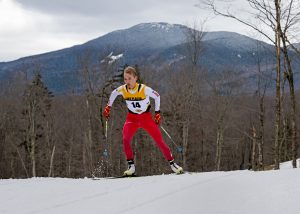
Breaking trail is tough work. It takes foresight to read the terrain, anticipate the obstacles, and choose a safe, efficient path forward. One that others can follow, too. At the Olympic Authority, we are applying that same spirit of leadership to every aspect of our operations, from snowmaking and mountain management to dining services and transportation.
By working proactively to transform everything we do, we are creating a more sustainable future, helping protect winter here at home, and setting an example for winter sport venues around the world. Our commitment is firmly rooted in our communities, in the natural landscapes we cherish, and in creating positive change for the generations who will follow.
From welcoming the world’s best athletes to the international stage to helping first-time skiers and snowboarders make their first turns, we are dedicated to preserving the experiences, traditions, and places that make winter special.
We are and always will be in harmony with winter.