The Science and Skill Behind the Snow
As warmer weather keeps skiers and riders waiting for opening day, a familiar question comes up: Why aren’t the snow guns running when it feels cold outside?
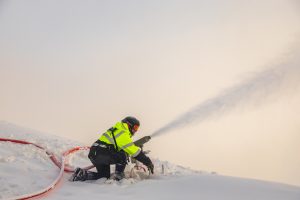
The answer involves more than the temperature. Making snow requires the right combination of weather conditions, equipment, and skilled people, and turning that snow into a trail ready for skiing takes additional time and preparation.
When conditions line up, crews make the most of the opportunity. Imagine working through the night. High on a mountain. In bitter cold. On steep terrain. With near zero visibility. Making snow is a challenging job. One that demands skill, grit, and determination.
Getting the job done right also requires an understanding of how temperature, humidity, water, and compressed air work together. This combination of human perseverance and science drives the technology that helps deliver the winter experiences skiers and riders love.
The Olympic Authority’s snowmaking systems give crews tools to manage energy use, water flow, and air pressure. Yet producing snow where and when it is needed still requires skilled people making informed decisions as conditions change.
THE SCIENCE BEHIND THE SNOW
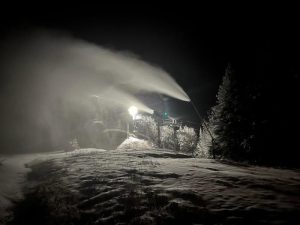
Wet-Bulb Temperature is one of the most important weather measures in snowmaking. Instead of just a standard thermometer reading, it combines the effects of temperature and humidity, making it a far more accurate measure of whether snow can be produced.
At 100 percent relative humidity, the wet-bulb temperature equals the ambient air temperature. In drier air, it is lower. This metric helps snowmakers predict how easily a tiny water droplet will freeze into a grain of snow. Even if it’s snowing at 32 degrees Fahrenheit, the wet-bulb temperature near the surface may prevent crews from making snow.
Nucleation and Rapid Expansion are essential pieces of the snowmaking puzzle, especially at marginal temperatures. Once the water passes through the gun’s nucleator, compressed air mixes with water and rapidly expands upon exit of the gun, helping create tiny ice particles that start the freezing process in the surrounding water droplets. The warmer the air outside the gun, the smaller the droplets generally need to be to freeze into grains of snow. In better, colder conditions, on the other hand, less compressed air may be needed, and larger droplets can freeze before reaching the ground.
Hang Time is the time droplets spend in the air after leaving the gun. Gun position, height, wind, and terrain all influence where the snow lands and how much time it has to freeze. Crews adjust their equipment to work with those conditions and place snow where it is needed.
ALPINE SNOWMAKING SYSTEMS
With high efficiency guns installed up and down our alpine mountains, most trails have their own pipes. Running just off each trail, one line carries compressed air, and one carries pressurized water. Additional pumps at higher elevations help push water farther up the mountain. Pipe size on each run depends on its proximity to the pumphouse and whether it supplies the trail alone or also feeds another pumphouse partway up the mountain.
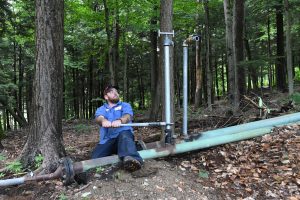 Water travels through pressurized pipelines at 400 to 900 pounds per square inch (psi), and the air lines operate at approximately 100 psi. Hydrants are spaced every 75 to100 feet allowing snowmakers to connect hoses – one each for air and water – which in turn, connect to snow guns.
“The water pipes lie largely empty when not in use and require charging or filling and pressurizing, to deliver water to snow guns,” notes Whiteface Mountain Operations Manager Nick Zachara. “Once the lines are charged, our crews manually adjust the snow guns and hydrants.”
Most of the snow guns on our mountains mix pressurized air and water outside of the gun. Some trails also carry electrical infrastructure used to power pumphouses and fan guns. Fan guns are larger and require electricity to power the fan motor onboard air compressor.
Pumps and compressors supply the pressurized water and air needed for snowmaking. Their motors may operate at a fixed speed or use a variable frequency drive (VFD), which allows motor speed to ramp up or down depending on demand and circumstances on the mountain. The newer, more efficient VFD systems are becoming the norm.
THE NORDIC SYSTEM DIFFERENCE

The pipe system for the Nordic trails at Mt Van Hoevenberg is similar to those at the alpine mountains, but the somewhat narrower trails move back and forth through the forest with dips and rises along the way. Eve
n with two pipelines operating at a time, snow can be made only on some parts of the trail network. That means additional time is needed to make snow on the remaining sections.
Additionally, to keep the lines from freezing, water must be drained from low points in the pipelines before snowmaking can resume elsewhere. These twists and turns, and elevation changes, add complexity and influence how crews move snow production around the venue.
These factors, along with the trails’ lower elevation compared with the alpine mountains, add to the challenge. Conditions at Mt Van Hoevenberg can differ from those at higher elevations, requiring crews to carefully assess the weather at their specific venue.
“There are a number of things that need to line up for our teams to make snow reasonably efficiently and safely,” says Allan Serrano, Trail and Cross-Country Manager. “It’s one thing to turn a couple of snow guns on, but firing up a whole high-pressure system is an elaborate undertaking.”
FROM SNOW GUN TO SKI TRAIL
Curing and Grooming comes after snow is made and hits the ground. Freshly made snow needs time in piles to sit and allow excess moisture to leech out – typically 24 to 72 hours, depending on the snow and weather conditions.
 Says Gore Mountain Operations Manager Derek Goodspeed, “Once the snow is ready, the groomer can push it over the trails and deliver great corduroy for skiers and riders. Snow that is still too wet when groomed out can freeze into a hard-packed surface that’s more difficult to ski and ride.”
Often, crews will manually move the guns around between the piles or as the wind changes to help fill gaps, reducing pile size and the time needed to cure.
Snow Depots are frequently produced at Mt Van Hoevenberg to improve efficiency and effectiveness. Just like the large piles, or “whales,” teams create at the alpine mountains, the Nordic snowmaking crew builds piles on trails or in the larger stadium areas.
“We’re going to have probably 60 days of good weather where we can make snow quite efficiently,” says Allan Serrano. “Periods when we’re maximizing water and electricity use. No one knows when those are going to happen, so depoted snow makes good use of these resources.”
At Mt Van Hoevenberg, depots of snow can be cured and pushed or hauled to another trail or part of the venue. Snow can also be stored over the summer months. Previously, the team covered giant snow piles with wood chips utilized as a large, insulated cover.
Automation with VFD controls on pumps and compressors helps improve efficiency and makes life a little easier on hardworking snowmaking crews. At the same time, crews appreciate maintaining control of gun positions, hydrant regulators, and other parts of the process.
“We enjoy the manual controls on our systems because it preserves some of the art involved with snowmaking,” says Ryan Becker, Head of Snowmaking at Belleayre Mountain. “Every gun used to be adjusted manually at the hydrant with someone checking every gun nonstop and adjusting it to make sure it was perfect. Now, as it gets colder, you flip a lever or press a button, giving it more water and less nucleation. Automation is a great improvement, of course, and it’s greatly improved life for snowmakers. Still, the art is where we find our greatest satisfaction.”
With or without VFDs, the process requires snowmakers to exercise informed, attentive judgement in the pumphouse and on the mountain. Every step of the way, they test the snow texture and adjust the systems as the temperature, wind, and humidity change.
WHERE GRIT AND SCIENCE MERGE
Even with the high-tech, high-efficiency, automated systems on Olympic Authority mountains today, snowmaking remains physically demanding work that requires diligence and determination.
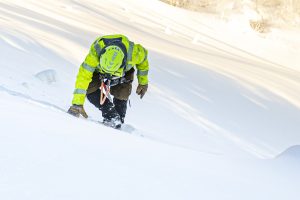
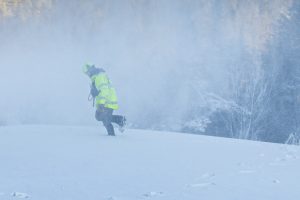 Working conditions can be extreme. Often cold. Often windy. Almost always wet with tiny droplets blasting from the snow guns. Dark nights. Steep and slippery slopes with every step.
Handling high-pressure systems in those conditions requires snowmakers to remain vigilant throughout their shift.
Despite the intense, grueling work – or maybe because of it – snowmaking comes with a brand of camaraderie and personal satisfaction most of us never see. The shared challenges make for a tight-knit crew. They seize opportunities throughout the season to take in the natural beauty surrounding them, such as watching the sunrise on a peaceful mountain. As a team, they also take great pride in building the snowpack and delivering great winter experiences for many thousands of skiers and snowboarders.
That pride is there long before the first chairlift carries guests up the mountain. During a warm start to the season, crews watch for opportunities to make snow and prepare terrain for opening. For everyone eager to get back on the slopes, the wait can be frustrating. Behind the scenes, every productive snowmaking window brings opening day closer.