In recognition of International Women’s Day, March 8
Few forces in this world are as powerful and transformative as sport. Whether training, competing, or cheering from the sidelines, sport changes lives. It builds confidence, teaches resilience, teamwork, and determination — qualities that extend far beyond the field of play.
Yet, despite its uniquely positive power, women and girls around the world continue to face significant barriers to participation and advancement in sport. These challenges vary across countries and cultures, and many are deeply rooted in systemic inequalities. Limited access to resources, unequal funding, lack of representation, and persistent stereotypes remain obstacles. Still, at every level and at every age, female athletes rise, persevere, and lead — reminding us all never to underestimate potential.
On International Women’s Day — March 8 — we join the global celebration of women’s achievements in every sphere of life. At the Olympic Authority, this occasion is an opportunity to reaffirm our commitment to empowering women and girls through sport. As stewards of Olympic legacy venues and year-round training centers, we proudly recognize the role athletics plays in advancing gender equality. We remain dedicated to expanding opportunities, strengthening support systems, and championing the success of women and girls in sport.
From Mt Van Hoevenberg serving as the birthplace of women’s sliding sports to our 2025 collaboration with the US Ski & Snowboard and USA Ski Jumping in support of equitable pay for women athletes at the first ever Women’s Ski Jumping World Cup event in the U.S., the Olympic Authority continues to demonstrate an ongoing commitment to achieving equity. Today, more athletes are training regularly at our venues, and we are proud to support here in Lake Placid to a growing number of women preparing for Olympic competition.
This weekend, that legacy continues as women take the ice at the historic 1980 Herb Brooks Arena for the ECAC Hockey Championships. Seeing women compete in the same rink that hosted the “Miracle on Ice” is a powerful reminder that history evolves — and that iconic stages belong to today’s generation of female athletes as well.
Breaking Barriers: Women’s Doubles Luge
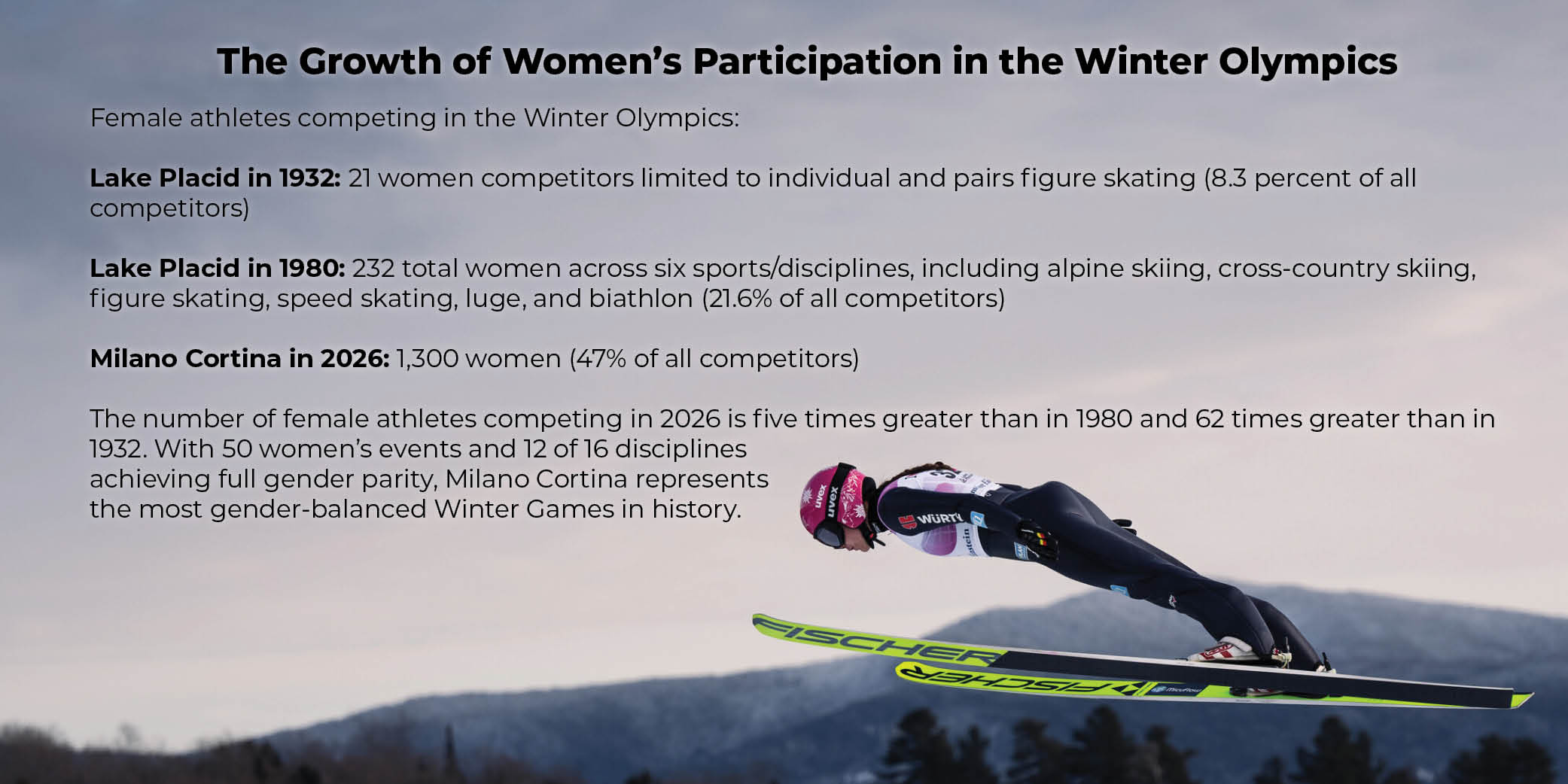
In one poignant and very recent milestone, USA Luge athletes Sophia Kirkby and Chevonne Forgan, who live and train in Lake Placid, made history by competing in the first-ever women’s doubles luge event at the 2026 Milano Cortina Olympic Winter Games. While men’s doubles luge has been a Winter Olympics staple since the 19642 Innsbruck Games 62 years ago, this marked the first time women were allowed to compete in the discipline.
After their debut Olympic performance in which they placed fifth, Sophie reflected:
“I’m so excited to just be here and have this Olympic experience. I’m really proud to just be one of the first women to compete in this sport ever. It’s a historic moment for women’s sports. * USA Luge website
Chevonne added:
“We hope that we are paving the way for future generations of women to show women and girls coming up in luge, and outside of luge, in the Winter Olympics in general, that you can do any sport, you can do whatever you want. We’re hoping this really inspires the next generation.”
Persistent Challenges Facing Women in Sport
While progress is undeniable, important challenges remain:
Cultural and Social Norms – Gender stereotypes, unequal family support, and restrictions on independence and participation continue to limit opportunity in many parts of the world.
Limited Access and Opportunity – Fewer school programs for girls, disparities in funding and facility quality, limited access to safe environments for training, and fewer female coaches and role models create structural gaps.
Financial Inequality – Women athletes often earn less prize money, receive lower sponsorship rates, and face disparities at elite levels of competition.
Media Underrepresentation – Women’s sports receive less broadcast time and coverage. Media attention often emphasizes appearance over performance, limiting visibility and endorsement opportunities.
Leadership Gaps – Though gaining momentum, women remain underrepresented in coaching, officiating, and executive leadership roles within sports organizations.
Intersectional Barriers – Race, ethnicity, disability, socioeconomic status, and geography can further amplify obstacles to participation and advancement.
Yet, with resilience, discipline, and perseverance come rewards. The journeys of athletes training and competing in Lake Placid are proof that these obstacles are being overcome and women in all sports are finding steppingstones to greatness.
From local teams and school competitions to elite international competitions, female athletes are forging bonds, shaping identities, embracing hard work, finding joy in competition, and building pathways toward their dreams.
Sport matters because it has the power to transform lives— both personally and globally. It builds resilience while teaching teamwork and leadership. It creates a vital sense of belonging within communities and across nations. And it offers hope, strength, courage, and confidence.
High flying freestyle aerials competitor Danielle Scott from Australia, who has trained and competed in Lake Placid since 2012 reflects on the evolution of women’s sport:
“The men have it a little easier having a bit more muscle, but that doesn’t mean we’re not capable. I’m proud to be doing triples and pushing the sport for women. I think we’re just in our own league, and we don’t need to compare ourselves to men. I love aerials, so let’s get the world behind us!”
Her Team USA counterpart, Winter Vinecki shares a similar perspective:
“It’s fun to be out there pushing the sport for women and throwing tricks some of the guys are doing and just doing my best. A lot of the women are now hitting the same jumps as the guys and doing triples, and we’re showing everyone the challenges in this sport are possible.”
In this way, sport has a rare ability to unite people across countries, cultures, backgrounds, and generations. It provides opportunities unlike almost anything else – through triumph and failure, effort and excellence – for people to share deeply human experiences that transcend differences.
Together, through sport, we can strengthen our neighborhoods, our towns, our nations, and our global community. By continuing to expand opportunity, invest in equity, and champion women at every level of competition, we move closer to a more inclusive future.
Because when women thrive in sport, they thrive everywhere. And when they thrive, we all move forward.